SAAR1 DayKATHA
Shri Ram Katha
श्री राम कथा
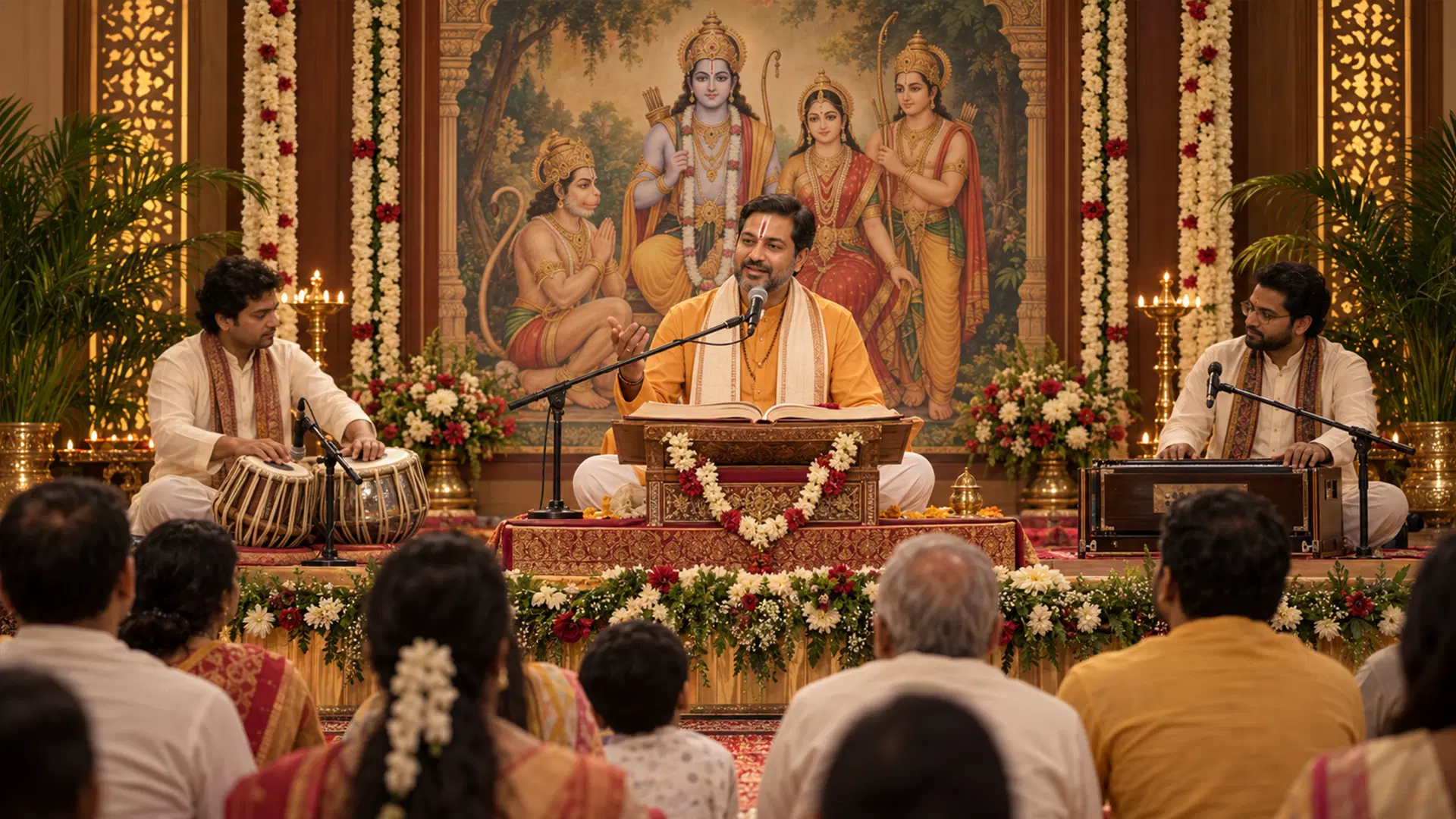
The charitra of Maryada Purushottam, sung as Goswami Tulsidas sang it and heard as Parvati heard it from Mahadev himself. Narrated day by day in the Narwar Dham parampara.
Important Note
Shri Ram Katha is led by a Vyas trained in the Narwar Dham parampara. The Katha is conducted at the family's home or chosen venue. The complete samagri, including the granth of the Katha, is arranged by the yajman as per the list on this page; the granth must match the katha being performed, and the Vyas guides the sthapana. Quantities are a base reference and scale with the format, and remaining daily-use items are confirmed on site with the Vyas team.
What Is This Katha?
The Ram Katha carries the charitra of Bhagwan Shri Ram as Goswami Tulsidas set it down in the Shri Ramcharitmanas, across seven sopans from Bal Kand to Uttar Kand, in the line of Maharishi Valmiki's Ramayan. The Manas holds the Katha inside a threefold samvad: Mahadev narrating to Parvati, Kagbhushundi to Garud, and Yajnavalkya to Bharadwaj at Prayag, so that to hear the Katha is to sit where Parvati sat. The tradition holds Ram Naam as the taarak mantra of Kaliyug; as Tulsidas writes, in this age there is neither yagya nor yog as the support, the one support is the singing of the gun of Ram. The Katha moves from the mahima of the Naam and the frame of Sati's doubt, through the causes of the avatar, to the Janmotsav of Shri Ram, the leelas of Ayodhya and the gurukul, the uddhar of Ahalya, the dhanush yagya and the vivah of Sita and Ram, and into the vanvaas, where the love of Kewat, the bhakti of Bharat, and the vijay of dharma complete the charitra. At SiddhiStar the Katha is led by a Vyas trained in the Narwar Dham parampara, with the family's gotra recorded at booking so the sankalp is offered correctly from the first day.
SiddhiStar Note
“As the parampara holds it, the Ram Katha is the Katha that Mahadev himself chose to tell. Sati doubted and tested, and the doubt itself became the doorway of the Katha. It is heard so that what wavers in the listener settles, the way water without shape becomes form when devotion cools it. Where other names ask for niyam, the Naam of Ram asks only to be spoken; the parampara recalls the soul carried to Vaikuntha in a palki for a single utterance, with the Lord standing to receive him with folded hands.”
Primary Deities
SHRI_RAM · HANUMAN_JI
Commonly Requested For
- •A barsi, shraddh, or remembrance for a departed family member, for the shanti and gati of the soul.
- •A milestone in the family such as a new home, a marriage, or a significant anniversary.
- •Fulfilment of a mannat or sankalp taken before the family deity.
- •Navratri and Ram-centric parv, including Ram Navami and the days around Vijayadashami.
- •Families seeking shanti and the easing of long-standing unrest in the household.
- •A community or society gathering hosted by one or more yajman families.
Samagri Required
Every item has a function - this is a functional manifest, not a shopping list.
Roli (100 gm)
रोली
Kumkum (100 gm)
कुमकुम
Haldi (100 gm)
हल्दी
Kalava (Moli) (10 nag)
कलावा (मौली)
Yajnopavit (12 nag)
यज्ञोपवीत
Chandan tilak (1 dibbi)
चन्दन तिलक
Sindoor (2 dibbi)
सिंदूर
Chawal (for akshat) (5 kg)
चावल (अक्षत हेतु)
Rang: kala, lal, hara, peela (As needed)
काला, लाल, हरा एवं पीला रंग; For colouring rice
Peeli sarson (100 gm)
पीली सरसों
Laung (100 gm)
लौंग
Elaichi (100 gm)
इलायची
Sabut supari (100 gm)
साबुत सुपारी
Paan ke patte (25 nag)
पान के पत्ते
Kapur (200 gm)
कपूर
Dhoopbatti (1 packet)
धूपबत्ती
Itra (scent) (2 sheeshi)
इत्र
Panch gulal (1 set)
पंच गुलाल
Panchmewa (500 gm)
पंचमेवा
Munakka (250 gm)
मुनक्का
Shahad (100 gm)
शहद
Boora / shakkar (1 kg)
बूरा / शक्कर
Desi ghee (2 kg)
देशी घी
SiddhiStar Samagri Policy
The core pujan structure remains the same across all durations; the difference lies in the extent of the katha, the time span, and the depth of prasang. Quantities below are a base reference: scale up for the longer formats, and remaining daily-use items are confirmed on site with the Vyas team on arrival.
Nandi Shraddh Samagri: Nandi Shraddh is the auspicious purvang offered before the Katha begins, invoking the blessings of the ancestors for the ayojan.
Accommodation and arrangements the family provides: Separate and clean accommodation for Vyas ji, and accommodation for accompanying sevaks, as applicable to the duration of the ayojan.; Clean water arrangement for bathing, and daily-use essentials.; Adequate electricity, fan, cooler or AC at the katha sthal.; Vyaspeeth, asan and sound system at the venue.; Daily prasad and bhojan arrangements..
FAQs
What does the 1 Day Saar cover?▼
The Saar is a single sitting that holds the spine of the charitra: the mahima of Ram Naam, the Janmotsav, the bal leela and the vivah of Sita and Ram, the vanvaas with the Kewat prasang and the bhakti of Bharat in essence, and the vijay of dharma to the rajyabhishek, with a short Poornahuti. It is chosen by families who wish to receive the Katha within one day.
How long is the Shri Ram Katha?▼
The Katha is offered in six formats, each as its own booking: the 1 Day Saar in a single condensed sitting, the 3 Day Compact, the 5 Day Vistaar, the 7 Day Traditional narrated day by day, the 9 Day Navahn with its more elaborate exposition, and the 15 Day Extended, which is planned together with our team.
Is the Katha from the Ramcharitmanas or the Valmiki Ramayan?▼
The narration follows the Shri Ramcharitmanas of Goswami Tulsidas, in the line of Maharishi Valmiki's Ramayan. The Vyas draws on the wider Ramayan tradition where the parampara does.
Do we need to arrange the Shri Ramcharitmanas ji pothi?▼
Yes. The family arranges the granth of the Katha, the Shri Ramcharitmanas (two copies, medium size), following the parampara rule that the granth must match the katha being performed. The Vyas guides the sthapana on the Vyaspeeth.
Can the Katha be held in memory of a departed family member?▼
Yes. Families hold the Katha for a barsi or shraddh, for the shanti and gati of a departed soul. The sankalp is offered accordingly, and the Vyas guides the family through the form.
Is there a good time of year for the Ram Katha?▼
The Katha is welcome in any shubh period. Families often choose Navratri, Ram Navami, and the days around Vijayadashami, and the Vyas can help align the start date with the panchang.
What is the Vyaspeeth and what do we arrange?▼
The Vyaspeeth is the raised and decorated seat on which Shri Ramcharitmanas ji is established for the duration of the Katha. The complete samagri and arrangements on this page, from the pujan items and kalash to the Vyaspeeth, asan and sound, are arranged by the yajman. Most items are commonly available, and our team shares this checklist at booking and remains available for any question through Talk to Us.
What is Poornahuti and is it included?▼
Poornahuti is the concluding Hawan offered on the final day, sealing the fruit of the Katha. It is offered as an opt-in with the 5, 7, 9 and 15 Day formats, where the home's fire safety arrangements permit. The hawan kund is arranged by the family.
Why does SiddhiStar ask for gotra at booking?▼
The sankalp of the Katha is offered in the name and gotra of the yajman family. Recording the gotra at booking allows the Vyas to perform the sankalp correctly in the parampara, so the Katha is held in the family's name from the first day.
Is Sundarkand Path part of this Katha?▼
The Sundarkand is narrated within the Ram Katha as part of the charitra. The Sundarkand Path as a complete single-sitting paath is offered separately as its own listing.
How is SiddhiStar different from other platforms?▼
The Katha is led by a Vyas trained in one lineage, the Narwar Dham parampara, rather than assembled from unconnected performers. The traditional sankalp is offered by gotra, the full vidhi of the Vyaspeeth and daily Aarti is observed, and the family receives the Katha within a single living tradition.
Starting From
₹51,000
Final price depends on the Kathavachak tier you choose next.
Contact Us · +91 84488 23454
Secure Payment · Refund policy applies