Shani Shanti
For the years Shani weighs heaviest. His beej mantra chanted to a disciplined count by lineage-trained pandits, and the fruit of that labour offered into the fire.
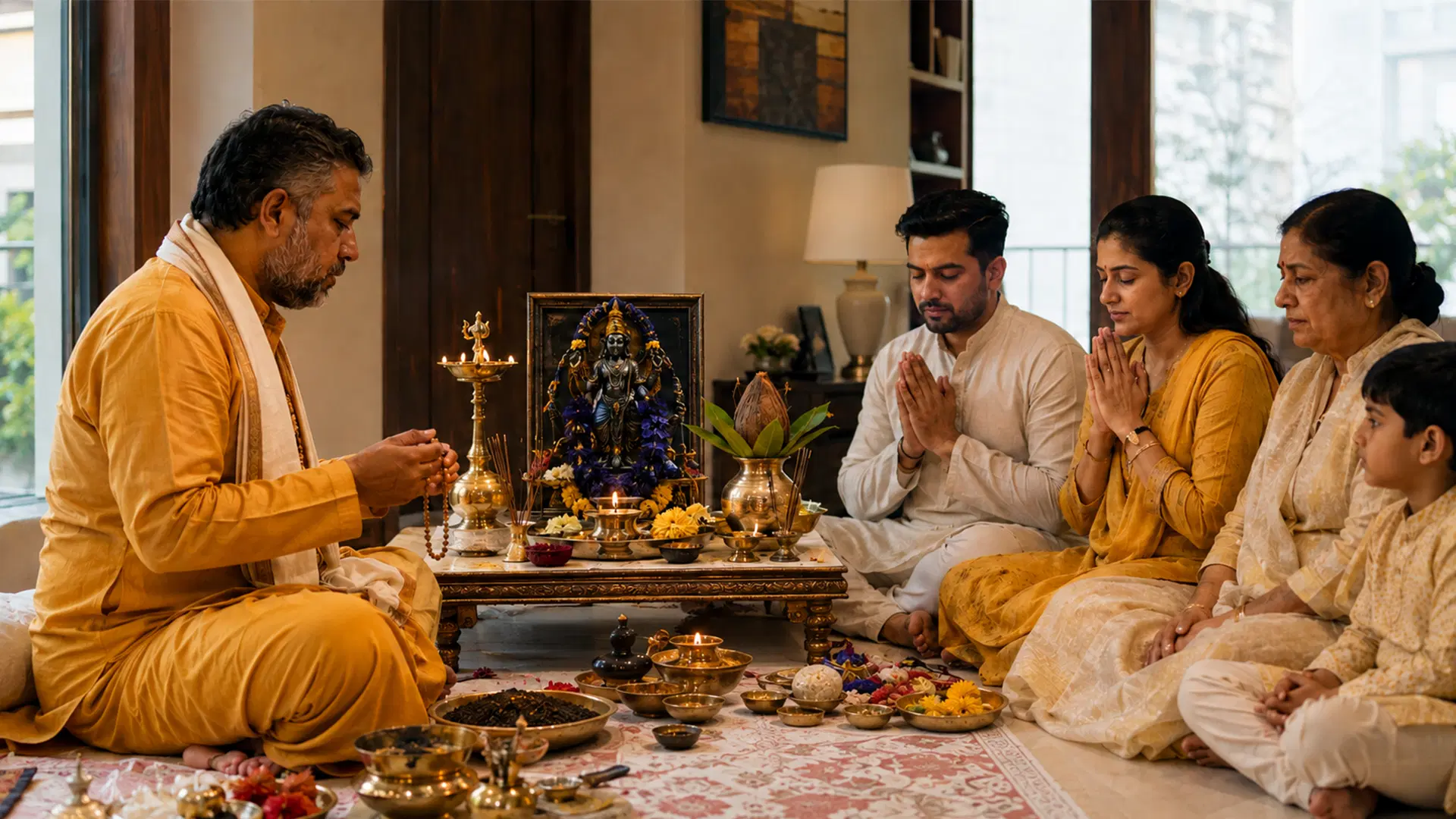
Overview
What is this anushthan?
Commonly requested for
- ●During Sade Sati, the seven-and-a-half year passage of Shani, when the family seeks to steady the phase
- ●During the Dhaiya, Shani's two-and-a-half year transit over the moon sign
- ●When effort meets repeated delay and obstruction that an astrologer reads as Shani's affliction
- ●On the advice of an astrologer prescribing a Shani anushthan as remedy
- ●For relief in matters of career, labour, and long-delayed results the parampara links to Shani
- ●As an annual Shani observance by families who keep his discipline each year
Ritual Flow
Understanding the sequence helps you participate meaningfully rather than merely observe.
Opening sequence
Pavitrikaran & Achaman
The pandit and the jaap sthal are purified with sacred water, and achaman is taken, before the anushthan begins.
Tilak, Bhasma & Mala Dharan
Tilak is applied, bhasma marked, and the jap mala worn, in the discipline the parampara asks of the one who chants.
Dik Rakshan
Yellow mustard is offered to the four directions to secure the jaap sthal.
Samagri Required
Every item has a function - this is a functional manifest, not a shopping list.
Roli (100 gm)
Tilak, sankalp
Moli / Kalawa (2 bundles)
Kalash, wrist
Chandan (20 gm)
Tilak, bhasma mishran
Abeer / Gulal (20 gm each)
Archan
Haldi (powder) (50 gm)
Archan, kalash
Kapur (camphor) (20 gm)
Aarti
Dhoop batti (1 packet)
Dhoop deep
Ruii (cotton) (10 gm)
Wick-making
Itra (5 ml)
Deity offering
Supari (7 pcs)
Sankalp, kalash
Nariyal (whole) (1 pc)
Kalash sthapana
Panchmewa (50 gm)
Naivedya
Rudraksha / jap mala (1)
For the jaap count
Janeu (5 pcs)
Deity, sankalp
What is arranged
- ●Til ka tel (mustard-sesame oil) - Shani's prescribed oil, for deepak and abhishek
- ●Iron item (kaali vastu) - Shani's metal, honoured in the rite
- ●Blue or black flowers - Shani's colour in archan
- ●Hawan samagri (mix) - Dashansh ahuti mix
- ●Aam ki lakdi / samidha - Hawan fuel
- ●Til, jau, akshat - Ahuti dravya
- ●Gola (purna-ahuti) - Purna-ahuti
- ●Ghee for ahuti
- ●Hawan kund - Dashansh hawan is integral
Important Note
Shani Shanti is chanted to the sankalpita sankhya by lineage-trained pandits, at home, hybrid, or online, sealed by the dashansh hawan. Name and gotra are recorded for the sankalp. The Puja and Hawan Samagri Kits are included in the price; the family arranges the puja-specific items, perishables, and hawan materials listed under Samagri. Benefits are as the parampara teaches, not assured. Sankhya and schedule are confirmed at booking.
Frequently Asked Questions
You Might Also Like

Chandra Graha Shanti
For the mind that will not settle. The Chandra beej mantra chanted to its count, for the peace the parampara places under the moon's care.

Budha Graha Japam
For clarity of intellect and speech. The Budha beej mantra chanted to its count, for the sharpness the parampara places under Mercury's care.

Guru Graha Shanti
For wisdom, marriage and the blessing of children. The Guru beej mantra chanted to its count, for what the parampara places under Brihaspati's grace.